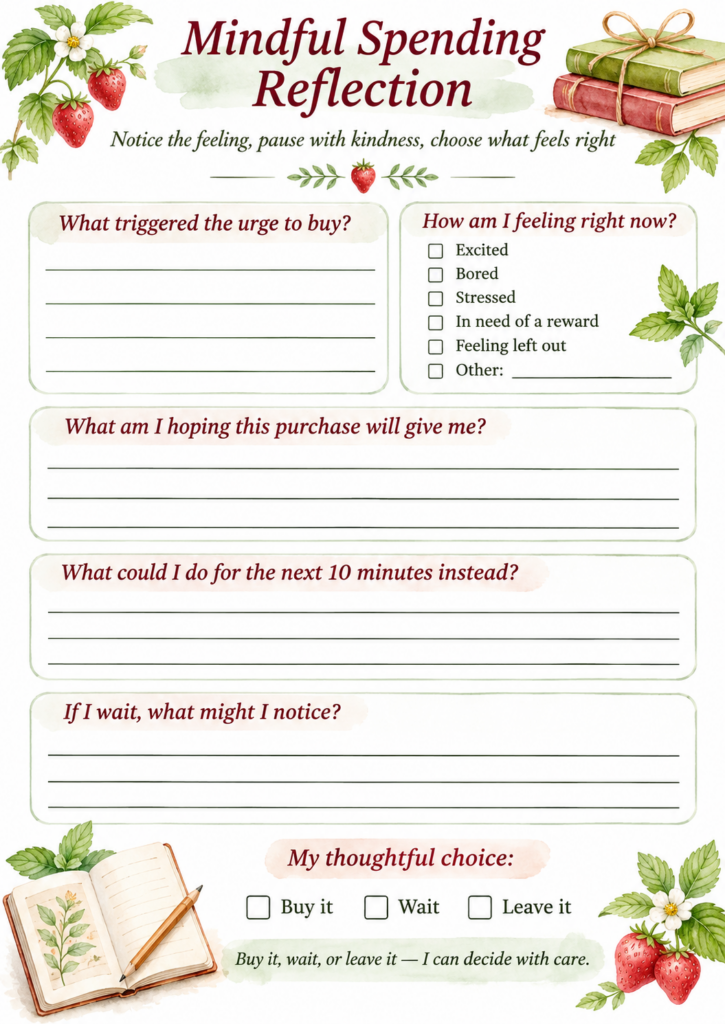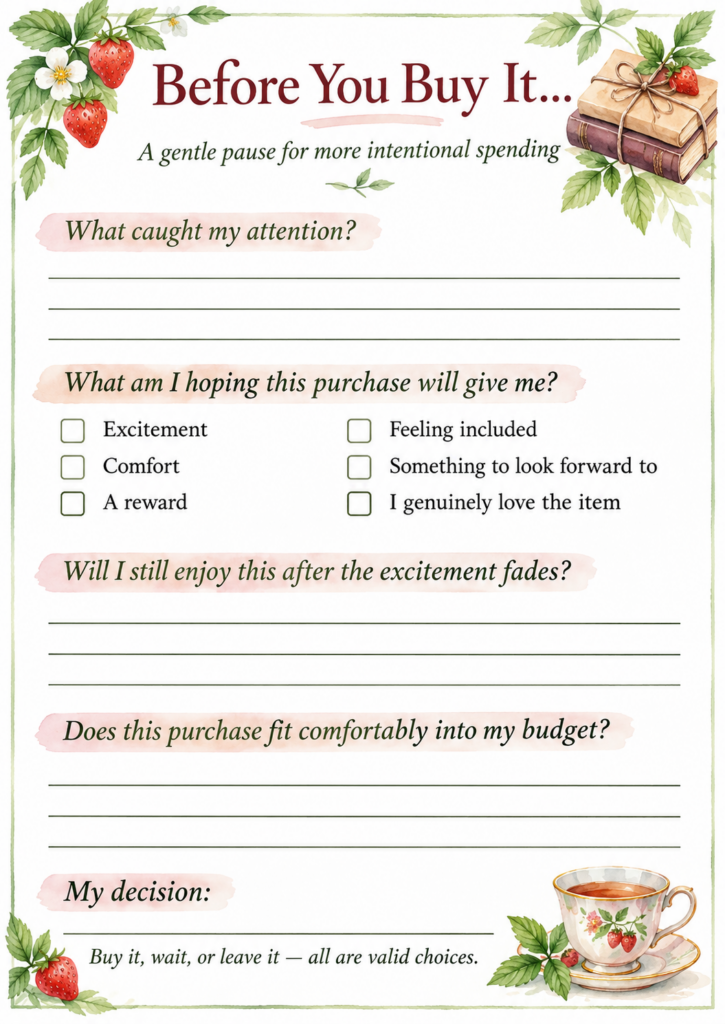
Free worksheet pages – at the bottom of this page
Have you ever bought something you hadn’t planned to buy, simply because it felt good at that moment?
Perhaps it was a beautiful book, a new outfit, something for your hobby or a little treat you spotted while browsing online.
You didn’t necessarily need it. You might even have something similar already.
But buying it felt exciting.
For a moment, you weren’t thinking about bills, responsibilities, unfinished tasks or all the things you should be doing. You were simply choosing something you wanted.
And sometimes, that feeling is wonderful.
There’s nothing inherently wrong with treating yourself, making spontaneous purchases or spending money on things that bring you pleasure.
But sometimes the feeling of freedom we get from buying something isn’t quite the same as having freedom over our money and choices.
And understanding that difference can help us enjoy what we buy without letting shopping quietly take control of our decisions.
Sometimes We’re Buying a Feeling, Not Just a Thing
Think about the last time you really wanted to buy something.
Perhaps you discovered a beautiful special-edition book. You imagined how lovely it would look on your shelf, how exciting it would be when the parcel arrived, and how much you’d enjoy opening it.
Or maybe you saw something for a hobby you love. A new collection of craft supplies, a board game, a lovely notebook or a piece of equipment that promised to make your favourite activity even more enjoyable.
Part of the excitement was about the item itself.
But perhaps another part was about everything surrounding the purchase.
The anticipation. The pleasure of choosing. The excitement of waiting for a delivery. The little moment of happiness when you open the parcel.
Sometimes we enjoy the experience of buying almost as much as the thing we’re buying.
And occasionally, even more.
That doesn’t mean the pleasure is imaginary or that the purchase was necessarily a mistake.
It simply means that shopping can provide more than material possessions.
It can offer excitement, comfort, a sense of possibility and something pleasant to look forward to.
The question is whether the item will continue to bring us enjoyment once that initial excitement has faded.
Why Shopping Can Feel Like Freedom
So much of everyday life is filled with obligations.
We have bills to pay, responsibilities to manage, appointments to remember and practical decisions to make.
Even when life is going reasonably well, there are plenty of things we don’t get to choose.
Shopping can feel different.
You see something you like. You decide you want it. You buy it.
For a brief moment, you’re doing something entirely because you want to.
And that sense of choice can be particularly appealing when other areas of life feel restricted.
Perhaps you’ve had a difficult week and want a reward.
Perhaps you’re bored with your routine and want something exciting to happen.
Or perhaps you’ve spent so much time taking care of everyone else’s needs that buying something for yourself feels like a rare opportunity to put your own wishes first.
These feelings are understandable.
Wanting something purely for yourself isn’t selfish. And enjoying a little luxury doesn’t make you irresponsible.
But it’s worth noticing when buying things becomes our main way of experiencing freedom.
Because if we always need to spend money to feel that we’re doing something for ourselves, our choices can become surprisingly limited.
When Everyone Else Is Spending: The Fear of Missing Out
Not every impulse purchase begins with an advertisement or an irresistible online offer.
Sometimes the temptation comes from simply being surrounded by other people enjoying themselves.
Imagine walking through your town centre on a Saturday afternoon.
The cafés are busy. People are carrying shopping bags. Friends are meeting for lunch, families are browsing the shops, and everyone seems to be treating themselves.
You might have gone into town without any intention of spending money.
But suddenly, going home empty-handed feels disappointing.
Why should everyone else get to enjoy a meal out or buy something lovely while you have to think carefully about every pound?
This feeling can be especially difficult when you’re living on a low income or managing a tight budget.
When you already have to make countless compromises, another afternoon of saying no to yourself can feel exhausting.
And sometimes what you’re missing isn’t really the shopping.
It’s the freedom to participate.
The pleasure of making a spontaneous decision without calculating the cost. The feeling of being included in ordinary experiences that other people seem to take for granted.
There’s an important difference here.
Choosing to spend less is not the same as having no choice but to spend less.
Someone who can comfortably afford a restaurant meal but decides to cook at home may feel wonderfully independent.
Someone who would love to eat out but can’t afford it may feel exactly the opposite.
The decision looks similar from the outside, but the experience is very different.
That’s why advice about replacing every expensive pleasure with a free activity can sometimes feel frustrating.
A walk in the park might be lovely, but it isn’t necessarily a substitute for the restaurant meal you genuinely wanted.
And being told to appreciate simple pleasures doesn’t make financial restrictions disappear.
People on limited budgets deserve enjoyment, treats and opportunities to participate in life just as much as anyone else.
The question isn’t whether you should allow yourself nice things.
It’s whether a particular purchase is something you genuinely want or something you’re buying mainly because you feel left out.
Sometimes spending money on a carefully chosen treat is absolutely worthwhile.
Other times, the pressure to keep up with everyone around you can lead to purchases that don’t really bring the satisfaction you hoped for.
Recognising the difference gives you a little more control over the decision.
Why the Excitement Sometimes Disappears
One of the curious things about shopping is that the anticipation can sometimes be more exciting than owning the item.
You discover something lovely.
You read the description, look at the pictures and imagine how you’ll use it.
Perhaps you return to the website several times before finally placing the order.
Then comes the excitement of waiting for the delivery.
But a few days after the parcel arrives, the item is sitting on a shelf or tucked away in a cupboard.
You still like it, perhaps.
You might even be glad you bought it.
But the excitement has faded.
And before long, something else catches your attention.
This doesn’t happen with every purchase, of course. Some things bring us pleasure for years.
But it’s worth asking whether we’re buying something because we’ll genuinely enjoy owning or using it, or because we’re chasing the pleasant feeling that comes with acquiring something new.
There’s also another possibility.
Sometimes we buy things for the life we imagine having rather than the life we’re actually living.
Beautiful notebooks for the organised person we hope to become.
Craft supplies for the projects we imagine making.
Books for the peaceful afternoons we dream of enjoying.
None of these purchases is necessarily wrong.
But if we repeatedly buy things for a future version of ourselves without finding time to use what we already own, we might be trying to purchase a feeling of possibility rather than something we need right now.
When Spending Starts to Reduce Our Freedom
Here’s the difficult part.
A spontaneous purchase can feel like freedom in the moment, but sometimes it leaves us with fewer choices afterwards.
Money spent on something we didn’t particularly want is money that isn’t available for something else.
Perhaps a day trip, a meal out, a hobby we genuinely enjoy, or simply a little financial breathing room.
And when money is tight, even relatively small purchases can add up.
That doesn’t mean every pound must be saved or that every purchase needs to be justified.
Life would be rather joyless if we treated every little pleasure as a financial mistake.
But there is a difference between spending money on something that genuinely enriches our lives and spending it automatically because we’re stressed, bored, frustrated or afraid of missing out.
Real financial freedom isn’t necessarily about never buying unnecessary things. It’s about having as much choice as our circumstances allow.
Sometimes that means enjoying a treat without guilt.
Sometimes it means deciding that we’d rather keep the money for something more important to us.
And sometimes it simply means waiting until we’re sure.
Before You Buy, Give Yourself a Little Space
One useful idea from impulse-control techniques is to create a pause between feeling an urge and acting on it.
Not to punish yourself.
Not to prove how disciplined you are.
Simply to give yourself the opportunity to make a decision without feeling rushed.
Here are a few ways to try it.
1. Ask what you’re really looking for
Before making an unplanned purchase, consider what you’re hoping it will give you.
Is it the item itself?
Or are you looking for excitement, comfort, a reward, a sense of control or something to look forward to?
There’s no wrong answer.
But recognising the feeling behind the purchase can help you decide whether buying something is the best way to satisfy it.
2. Try the ten-minute pause
If you feel a sudden urge to buy something, try waiting ten minutes.
Close the shopping tab, step away from the display or simply carry on browsing without making a decision.
You don’t have to promise yourself that you won’t buy it.
You’re just giving the initial excitement a little time to settle.
Sometimes you’ll realise you weren’t particularly interested in the item after all.
Other times, you’ll still want it.
Either outcome is useful information.
3. Leave non-essential purchases for another day
For larger purchases, or things you’re unsure about, consider waiting 24 hours or longer.
You could save the item to a wishlist rather than buying it immediately.
If you still want it later, and it fits comfortably within your budget, you can make the purchase with greater confidence.
Of course, not everything requires a waiting period. A small, affordable treat doesn’t need to become a complicated decision.
The idea is to make waiting an option, not another strict rule.
4. Notice when you’re most tempted to spend
Do you tend to browse online shops when you’re tired?
Are sales emails particularly tempting after a difficult day?
Do you feel an urge to buy something when everyone around you is shopping?
Or do you find yourself wanting new things whenever you’re bored?
Noticing these patterns can be surprisingly helpful.
You might discover that certain situations make spending more appealing, even when you weren’t looking for anything in particular.
And once you recognise a pattern, you can decide whether you want to change it.
5. Make shopping a little less automatic
Online shopping makes it incredibly easy to go from wanting something to owning it.
A saved payment card, a tempting email and a couple of clicks can turn a passing thought into a purchase.
If this happens more often than you’d like, you could unsubscribe from promotional emails that constantly tempt you, remove saved payment details or stop browsing shopping apps when you’re feeling bored.
These aren’t rules everyone needs to follow.
They’re simply ways to make sure your purchases happen because you’ve chosen them, rather than because buying was the easiest thing to do.
You Don’t Have to Replace Every Treat With Something Free
There’s plenty of advice suggesting that whenever you want to spend money, you should do something free instead.
Go for a walk. Read a book. Make a cup of tea.
And sometimes those are genuinely lovely alternatives.
But they aren’t always what you want.
If you’ve been looking forward to visiting a café, reading a book at home isn’t necessarily going to provide the same experience.
If you love collecting beautiful books, borrowing one from the library might not satisfy the pleasure of owning a special edition.
And that’s fine.
The goal isn’t to convince yourself that you shouldn’t want anything that costs money.
It’s to make your spending reflect what matters to you.
Perhaps you genuinely love going out for coffee, but don’t care much about buying new clothes.
Perhaps books are your favourite luxury, while expensive meals don’t particularly interest you.
Or perhaps you’d rather save for an occasional weekend away than spend small amounts on things you barely remember buying.
Intentional spending isn’t about choosing the cheapest possible life. It’s about choosing where your money makes the biggest difference to your enjoyment of life.
And if your budget doesn’t currently allow for something you really want, you’re allowed to feel disappointed.
You don’t have to turn every restriction into a lesson about gratitude.
What If You Still Want to Buy It?
Then perhaps buying it is the right choice.
Not every impulse is something we need to resist.
Sometimes we discover something unexpectedly, recognise that we’d genuinely enjoy it, and decide it’s worth the money.
A spontaneous purchase can become a treasured possession or a wonderful memory.
The important thing is whether the decision feels right for you, rather than being driven entirely by pressure or a fleeting emotion.
You might ask yourself:
- Do I want this particular thing, or mainly the excitement of buying something?
- Will I enjoy using or owning it after the initial excitement has faded?
- Am I buying it because I genuinely want it, or because I feel left out?
- Can I comfortably afford it without sacrificing something more important to me?
- If I leave it until tomorrow, will I still want it?
These questions aren’t a test you have to pass.
They’re simply a way to understand your own choices a little better.
And sometimes the answer will still be: Yes, I want it, I can afford it, and I’m going to enjoy it.
That’s a perfectly reasonable outcome.
Spending With Intention, Not Perfection
January often arrives with a long list of things we’re supposed to change.
Spend less. Save more. Declutter. Stop shopping. Become more disciplined.
And after the expense of Christmas, it can feel as though we’re expected to spend the entire month making up for our previous indulgences.
But perhaps we don’t need another strict challenge.
Perhaps we simply need a little more awareness of how and why we spend.
Impulse buying isn’t always about a lack of self-control.
Sometimes it’s about excitement, comfort, frustration, the desire for something beautiful or the wish to feel that we have choices.
Those feelings deserve to be understood, not dismissed.
And there’s nothing wrong with wanting lovely things or enjoying the occasional treat.
But when we recognise what we’re really looking for, we give ourselves more opportunities to decide whether a purchase is worth making.
Sometimes we’ll buy the thing.
Sometimes we’ll wait.
And sometimes we’ll discover that what we wanted wasn’t really the item at all.
Freedom isn’t about never spending money. Nor is it about being able to buy everything we want.
It’s about making the most meaningful choices we can within our circumstances, without allowing pressure, habit or the fear of missing out to make those decisions for us.
And that seems like a much kinder way to begin a new year than promising ourselves we’ll never make another impulse purchase.
If you’re looking for a gentler approach to January, you might also enjoy Why You Don’t Need a New Life in January (and How to Grow on Your Own Terms).
Before you go, check our latest posts:
- Why Impulse Spending Feels Like Freedom (And How to Spend Mindfully)
- Things to Do in January in the UK: Events & Cosy Ideas
- 12 Things to Do Before the Year Ends | A Gentle December Bucket List
- How to Enjoy Christmas Alone: 8 Cosy Ideas for Christmas Day
- 5 Cosy Tea Recipes for Chilly Autumn Days
Enjoyed this? Stay for tea.
Get new seasonal printables, cosy ideas and creative ways to make everyday life feel a little freer — delivered occasionally to your inbox:
Download these pages for free (just right click and select Save as…):