
Introduction – Working from Home Isn’t Always as Peaceful as It Looks
Working from home sounds wonderfully peaceful… until someone needs help finding their favourite toy, the washing machine starts beeping, the doorbell rings, and you realise you’ve somehow wandered into the kitchen without remembering why.
If you’ve ever looked at those perfectly organised home office photos and wondered what you’re doing wrong, let me reassure you—real life rarely looks like that.
The good news is that you don’t need a Pinterest-worthy office or eight uninterrupted hours to have a productive day. A few simple habits can make working from home feel much less stressful, even if life keeps interrupting you.
1. Create a Workspace That Saves You Time
Your workspace doesn’t have to be beautiful. It just needs to work.
Keep the things you use every day within easy reach:
- laptop charger
- notebook and pen
- water bottle or mug of tea
- headphones (if you use them)
The less time you spend hunting for things, the easier it is to get started.
My desk certainly isn’t always spotless, but at least I know where the charger lives.
2. Plan Less, Prioritise More
It’s tempting to write a huge to-do list every morning, but endless lists often make us feel overwhelmed before we’ve even begun.
Instead, choose your three most important tasks for the day.
If you finish those, anything else is a bonus.
Having a clear priority makes it much easier to decide what deserves your attention when the day inevitably becomes a little chaotic.
3. Learn to Work in Small Chunks
One of the biggest mistakes I used to make was waiting for a long stretch of uninterrupted time.
It almost never arrived.
Instead of thinking you need two or three free hours, look for opportunities to make small pieces of progress.
You might:
- write one paragraph
- answer three emails
- edit one image
- create one printable page
- research one keyword
These small chunks may not feel impressive on their own, but they add up surprisingly quickly.
4. Be Flexible with Family Life
If you have children at home, you’ll probably hear plenty of advice about setting firm boundaries. And for some families, that works brilliantly.
But every child is different.
Some can happily wait while you finish an email. Others may become increasingly upset if they feel ignored, and what started as a two-minute task can quickly turn into a much longer battle.
Over time, I’ve found it helps to work with my children’s rhythms rather than against them. Pay attention to their usual attention span, the times of day when they’re happiest playing independently, and the little things that tend to trigger frustration.
Then ask yourself one simple question:
Is this interruption worth the battle?
If your child simply needs help finding their favourite cartoon on a tablet, it may be quicker to spend thirty seconds helping them than to spend the next fifteen minutes trying to finish your work while calming an increasingly unhappy child.
On the other hand, not every request needs an immediate response. As with everything else, it’s about choosing your battles.
5. Not Every Distraction Needs Your Attention
Working from home means you’re surrounded by jobs that quietly ask for your attention.
The dishwasher has finished.
The laundry is ready.
The post has arrived.
You notice a pile of clothes waiting to be folded.
None of these jobs are shouting at you, but they’re very good at tempting you away from what you were doing.
I’ve learned to ask myself one simple question:
Does this actually need doing right now?
Quite often, the answer is no.
The dishwasher will still be there in half an hour. The washing can usually wait until you’ve finished the task you’re working on. Even the post doesn’t have to be opened the moment it lands on the doormat.
Of course, there are exceptions. If your toddler has just discovered a permanent marker or the dog is enthusiastically emptying the kitchen bin, that’s probably worth dealing with immediately!
The trick is learning the difference between urgent and simply visible.
Just because something catches your eye doesn’t mean it deserves your attention.
6. Make It Easy to Pick Up Where You Left Off
Interruptions are part of working from home. The real challenge isn’t stopping what you’re doing—it’s remembering exactly where you were when you finally sit down again.
If you’re anything like me, your brain can switch tracks remarkably quickly. You help someone, answer a question, make a cup of tea, and suddenly you’re looking at your computer thinking:
“Now… where was I?”
That’s why I started making a simple “Where Was I?” note.
Before I get up, I quickly write down:
- the current time
- what I was working on
- the very next step
For example:
10:35 – editing blog photos. Next: crop first image.
or
2:10 – writing introduction. Next: add example about working in short chunks.
It takes less than ten seconds, but it saves me from trying to rebuild my train of thought later.
A few other little tricks help too:
- Leave one obvious step unfinished so it’s easy to jump back in.
- Leave your current document or project open and ready to continue. (If your browser already has enough tabs to qualify as modern art, this isn’t permission to open another one!)
- Spend thirty seconds getting your bearings before diving back into work.
- Ask yourself: “What’s the next smallest thing I can do?”
Sometimes that’s all it takes to get moving again.
7. End the Day by Helping Tomorrow You
Before you finish for the day, spend just a few minutes making tomorrow a little easier.
Clear away anything you don’t need.
Write down tomorrow’s top three priorities.
Close the programs you’re finished with.
Leave your notebook open or your project ready for the next session.
It only takes a few minutes, but Tomorrow You will be grateful.
Conclusion
Working from home will probably never be interruption-free—and that’s perfectly normal.
Instead of chasing the perfect routine, focus on building simple systems that help you make progress despite the interruptions.
Some days you’ll finish everything on your list.
Other days you’ll answer a few emails, write a paragraph and somehow keep everyone fed and happy.
Both kinds of days count.
Productivity isn’t about having perfect conditions. It’s about making the most of the conditions you have.
If you’d like to learn more about work-from-home mindset, take a look at this post – https://www.strawberryminttea.co.uk/work-from-home-mindset/ or this one – https://www.strawberryminttea.co.uk/how-can-i-make-working-from-home-a-success/
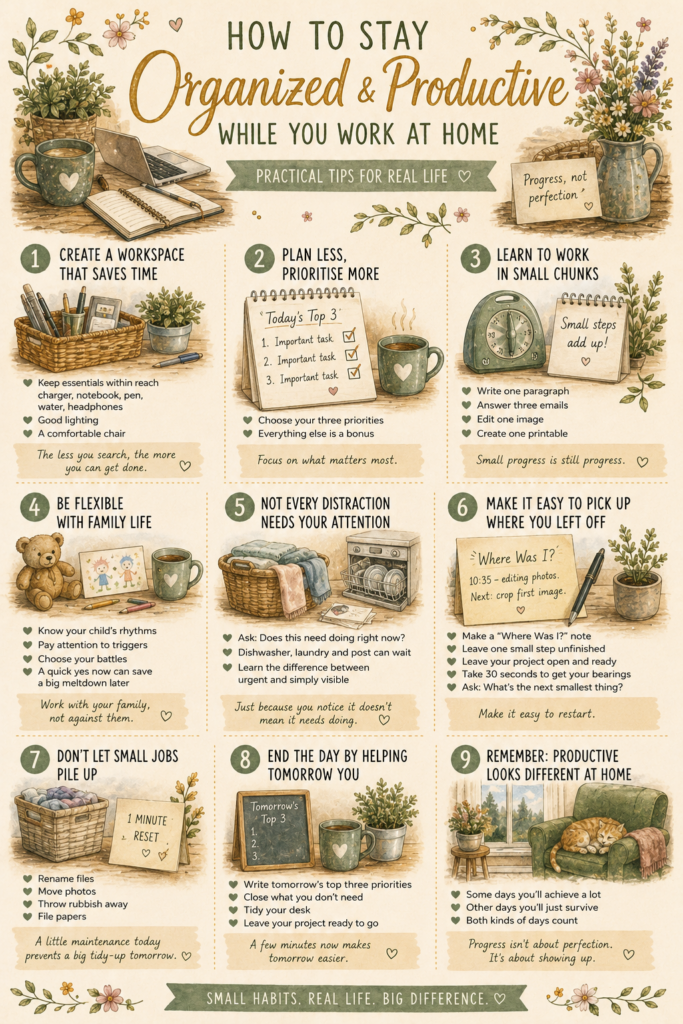
Download this poster for FREE (just right click and select Save as…):
- How to Bring a Little Gilmore Girls Autumn Into Your Life
- 25 Things to Do Before Autumn Ends
- How to Enjoy Rainy and Gloomy Days: Finding Freedom in Grey Weather
- How to Plan Your Week When You Hate Planners
- 25 Freedom-Inspired Walk Ideas in Britain